The Application Review Committee (ARC) was established by Executive Order 96-26 and is formulated for the purpose of providing the Guam Land Use Commission (GLUC) and Guam Seashore Protection Commission (GSPC) with technical and professional review, analysis, and advice through individual agency positions concerning various development activities on Guam.

Within its mandated area of authority, each ARC agency is required to:
• Ensure compliance with applicable law, regulatory standards, procedures, policies, and rules within its mandated area of concern;
• Evaluate alternative development strategies with the applicant to provide the best development plan for the developer and the community; and
• Develop and provide official position statements on applications submitted to the GLUC and GSPC.
As a member of the ARC, GCMP provides technical analysis and advice to the Guam Land Use Commission on development activities that do not meet zoning codes through position statements. The Bureau forwards a position statement for each application reviewed to the GLUC for approval or disapproval.
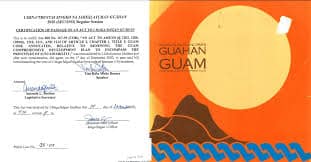 On December 1, 2020, Public Law 35-110 was passed. This law amended §§ 1203, 1204, 1205, 1205.1, 1206, 1209(H), 1210, 1211, 1212, 1213, and 1214 Of Article 2, Chapter 1, Title 5, Guam Code Annotated, Relative to renewing the Guam Comprehensive Development Plan to encompass the principles of sustainability. In accordance with Public Law 35-110, the plan is named The Guåhan 2050 Sustainability Plan (G50SP).
The Guåhan 2050 Sustainability Plan is not simply a land use map—it is a living commitment to the people of Guam. It recognizes that every decision about where and how we build, protect, and invest has consequences for generations. By integrating environmental stewardship, economic opportunity, and cultural preservation, the plan charts a path that is both ambitious and grounded in community priorities.
Guam’s Choice for the Future
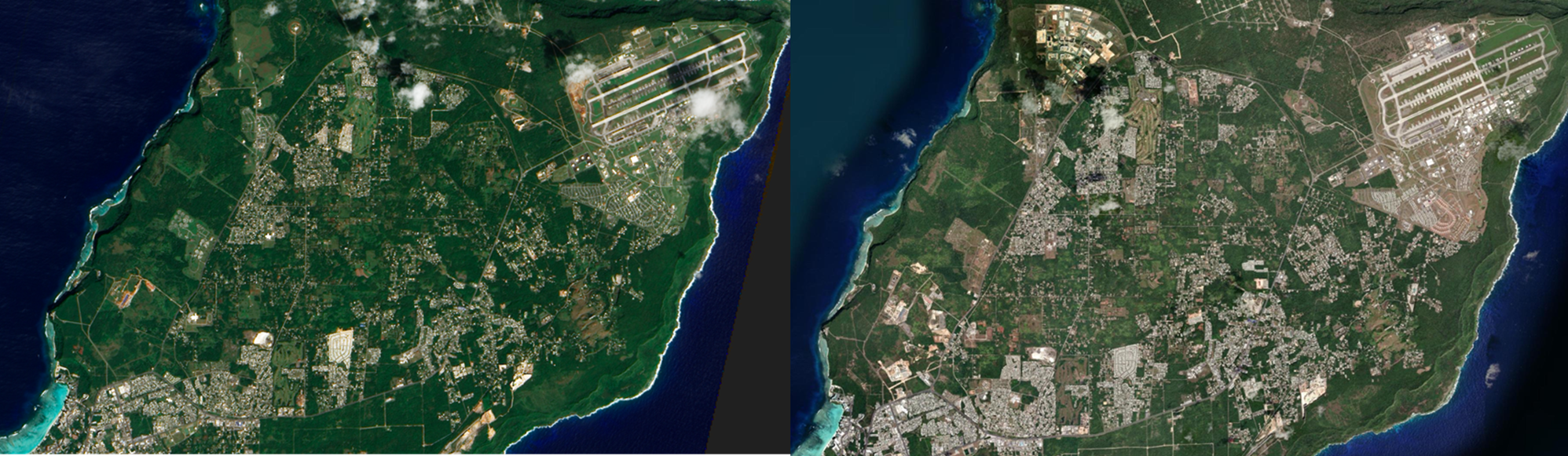
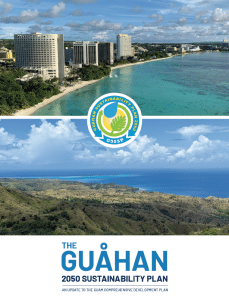 By 2050, Guam can be a place where vibrant villages, a prosperous economy, a thriving environment, and a celebrated culture reinforce one another—where development decisions respect the limits of our island, balance competing needs, renew our natural resources, ensure equity, and engage everyone in shaping the future. We face converging challenges: climate change bringing hotter days, rising seas, and stronger storms; global economic forces impacting tourism, defense, and local industries; rapid population and land use pressures from military expansion and urban growth; and cultural change that risks eroding CHamoru heritage and community life.
The Guåhan 2050 Sustainability Plan (G50SP) is Guam’s roadmap to meet these challenges. It was created through broad community engagement, guided by Public Law 35-110, and aligned with the United Nations Sustainable Development Goals.
Core Values and Principles
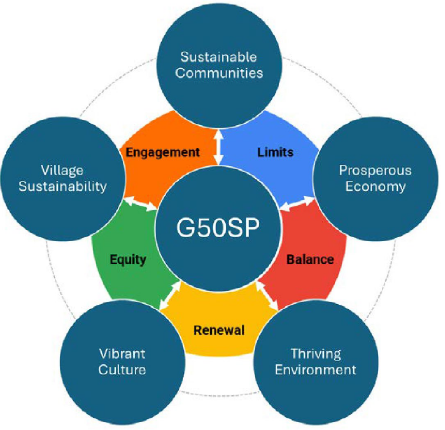 The G50SP is guided by five core principles that serve as a compass for all its policies:
Limits – Respect ecological and infrastructure thresholds.
Balance – Integrate environmental, economic, and cultural needs.
Renewal – Revitalize the built environment; restore degraded lands, waters, and heritage.
Equity – Ensure fairness in access to land, resources, and opportunity.
Engagement – Include all voices in decisions and implementation.
These principles are embedded within five thematic goals of the G50SP: Sustainable Communities, Prosperous Economy, Thriving Environment, Vibrant Culture, and Village Sustainability. Each goal has a dedicated chapter in the plan, with policies and objectives that respond to Guam’s unique challenges and opportunities.
Big Ideas and Policies
The G50SP’s land use policy framework is the backbone of the plan. It organizes many hundreds of interrelated policies across the five thematic chapters into a coherent system designed to guide development, conservation, and infrastructure investments through 2050. At its core, the framework:
Sets clear spatial priorities – Urban growth is directed to areas with existing infrastructure, while rural landscapes, watersheds, aquifers, and cultural heritage sites are conserved through protective zoning and overlays. Green infrastructure and coastal resiliency are prioritized by plan policies.
Integrates hazard and climate data – Flood maps, sea level rise projections, and hazard overlays shape where and how building can occur, reducing long-term risk.
Connects land use to infrastructure – Development approvals are tied to the capacity and resilience of water, wastewater, stormwater, energy, and transportation systems.
Balances economic and cultural objectives – Policies encourage redevelopment of underused urban areas, support small business and eco-cultural tourism, and protect agricultural lands to strengthen food security.
Elevates village planning – Each village’s character, priorities, and needs are reflected in context-specific land use policies, ensuring growth supports rather than erodes local identity.
This integrated approach replaces fragmented, sector-by-sector decision-making with a shared, island-wide framework that still leaves room for village-level flexibility. By embedding environmental stewardship, cultural preservation, and economic opportunity into the same decision process, the framework helps avoid conflicts, streamline permitting, and ensure cumulative gains toward sustainability.
From Plan to Action – Integrated Governance for a Sustainable Guam
Turning the vision into reality will depend on how Guam governs its land and resources over time. The G50SP implementation will be coordinated by the Bureau of Statistics and Plans, supported by a Sustainability Plan Implementation Task Force. Actions are phased into short-term (2025–2030), mid-term (2030–2040), and long-term (2040–2050) horizons. The G50SP implementation roadmap emphasizes more integrated governance that is:
Coordinated – Aligning the actions of agencies responsible for planning, infrastructure, environment, and cultural heritage so decisions reinforce rather than conflict with one another.
Accountable – Assigning clear responsibility for outcomes, tracking performance against measurable indicators, and reporting results to the public, the Legislature, and village leaders.
Transparent – Making planning data, maps, and progress reports publicly accessible and understandable.
Inclusive – Engaging village mayors, the Municipal Planning Councils, cultural organizations, and residents—recognizing tribal and indigenous governance roles as equal partners in decision-making.
Adaptive – Reviewing policies regularly, learning from results, and updating approaches in response to new challenges, science, and community priorities.
This governance-centered approach ensures that land use planning is not a one-time exercise, but an ongoing process of balancing competing needs in a way that builds trust, reduces uncertainty, and strengthens Guam’s resilience. The G50SP is as much about how decisions are made as it is about what decisions are made, recognizing that strong institutions and sustained community partnerships are essential to securing the island’s shared future.
Ultimately, it will be up to the people of Guam, working together and with an enduring commitment to a common purpose, to realize the vision of a sustainable, equitable Guåhan for present and future generations.
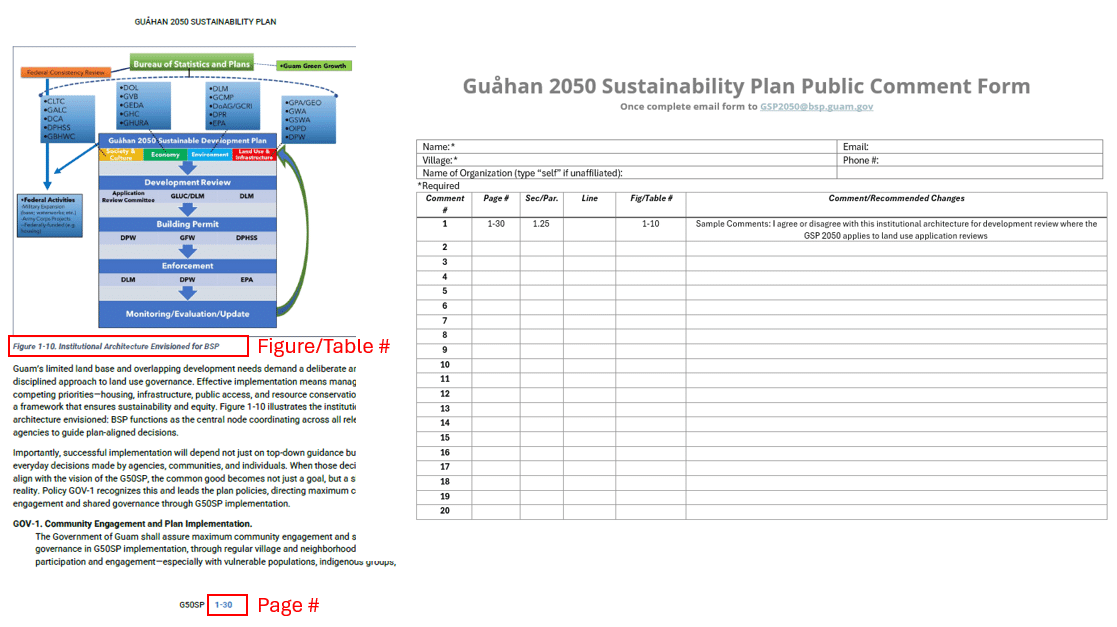
To download the Public Comment Form click here. Comments from the public can be emailed to gsp2050@bsp.guam.gov. If your comments are specifically associated with a section, page number, figure or table, please cite those details in the form. This will allow BSP and it’s consultant to associate the context of your issues or recommendations. BSP will be accepting public comments on the plan through May 22, 2026. Comments from the public will be submitted with the final draft of the plan that will be submitted to the Governor and the Guam Legislature.
Questions or request for additional information can also be sent to gsp2050@bsp.guam.gov.

Christian Benitez
Planner, GUam Coastal Management Program