
FEDERAL CONSISTENCY

What is Federal Consistency?

The basic consistency requirement of the CZM Act is that federally conducted or supported activities which directly affect the coastal zone be consistent to the maximum extent practicable with an approved state management program.

LEARN MORE ABOUT FEDERAL CONSISTENCY

ABOUT FEDERAL CONSISTENCY
The Guam Coastal Management Program’s (GCMP’s) procedures for federal consistency respond to the requirements of the Coastal Zone Management Act of 1972, as amended, as specified in Code of Federal Regulations, 15 CFR Part 930. The basic consistency requirement of the Act is that federally conducted or supported activities that directly affect the coastal zone be consistent to the maximum extent practicable with an approved state management program. Also, applicants for federal funding will be required to determine whether their projects that affect the coastal zone are consistent with the Program. The Territory generally will be able to prevent actions (with exceptions as explained in this section and the Code of Federal Regulations) that are not consistent with the GCMP.
The Bureau of Statistics and Plans, in the Office of the Governor, is the lead agency designated pursuant to 15 CFR 923.53(a)(1) and 15 CFR 930.18. Guam’s “coastal zone” includes all non-federal property on the island, including such areas on all offshore islands and submerged lands and waters extending seaward from such property to a distance of three nautical miles. While federal lands are excluded from the coastal zone, activities on federal lands with direct or indirect (cumulative or secondary) effects to Guam’s coastal uses or resources must be consistent to the maximum extent practicable with the GCMP.
While the area seaward of the territorial sea is legally excluded from Guam’s coastal zone, there is a potential for impacts to occur within the zone which would result from activities occurring on the seaward, or excluded, side of the three nautical mile limit. Federal activities seaward of the three nautical mile limit that have direct or indirect effects on Guam’s coastal uses or resources within the three nautical mile limit must be consistent with the GCMP, at least as far as these effects are concerned.
Federal consistency gives Guam, through GCMP, a strong voice in federal agency decision-making for activities that affect Guam’s coastal uses or resources. Generally, federal consistency with GCMP requires that federal actions, within and outside Guam, which have reasonably foreseeable coastal effects, must be consistent with the enforceable policies of Guam’s federally-approved coastal management program. These actions include federal agency activities, federally licensed or permitted activities, and federal financial assistance activities by state and local government. The enforceable policies of GCMP were adopted by Guam Executive Order 78-37, promulgated by Governor Ricardo J. Bordallo in 1978, and are listed as follows:


Development Policies
Resource Policies
• Shore Area Development
• Urban Development
Rural Development
Major Facility Siting
Hazardous Areas
Housing
Transportation
Erosion and Siltation
• Conservation of Natural Resources
• Air Quality
Water Quality
Fragile Areas
Living Marine Resources
Visual Quality
Recreational Areas
Public Access
Agricultural Lands


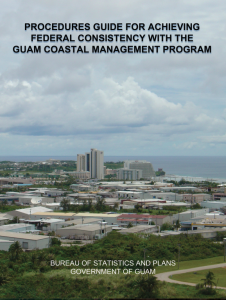
GCMP has developed a guidebook to serve as a reference for federal agencies, applicants, and applicant agencies to understand the federal consistency process, called Procedures Guide for Achieving Federal Consistency with the Guam Coastal Management Program. If you are working on behalf of a federal agency, applicant, or applicant agency to prepare a submission for federal consistency, please consult the Procedures Guide, and reach out to GCMP’s point of contact for Federal Consistency, listed below, for any additional assistance you may need.
Links to further information about Federal Consistency:
Coastal Zone Management Act of 1972, as amended
Federal Consistency Regulations, Code of Federal Regulations, 15 CFR Part 930
NOAA Federal Consistency Overview and Resources
Guam Executive Order 78-37
 
Federal Activity and Coastal Zone Management
Federal activity includes a federal agency’s development or function, such as adopting management plans, building nearshore facilities, or dredging channels. For coastal zone management purposes, the federal agency must determine if any coastal effects from the activity are “reasonably foreseeable”. If so, the agency must then prepare a “consistency determination” to show the activity is consistent with the state’s coastal management plan.
Examples of Federal Activities
Activities by or for a federal agency that may trigger a coastal effects review include:
• Management: Adopting a management plan for a wildlife sanctuary.
• Construction: Building nearshore facilities or other structures.
• Dredging: Creating or expanding channels.
• Military: Activities related to military facilities.
• Offshore: Projects involving offshore oil, gas, and mineral development.
The Consistency Determination Process
The process for ensuring federal activities align with state coastal policies involves several key steps outlined under the U.S. Coastal Zone Management Act (CZMA):
1. Determine Effects
The federal agency first determines if the activity has reasonably foreseeable effects on any land or water use or natural resource in the coastal zone. This includes both direct and indirect effects.

2. Prepare Consistency Determination
If effects are foreseeable, the agency prepares a determination describing the activity and how it is consistent with the state’s enforceable policies.

3. State Review
The responsible state agency has a set period (e.g., 60 days) to review the determination and either concur with or object to it in writing.

4. State Concurrence or Objection
If the state concurs, the activity can proceed. If the state objects, the activity cannot proceed unless the federal agency provides a legal basis for proceeding or the objection is overridden by the Secretary of Commerce.

For detailed guidance and resources on the federal consistency process, visit the NOAA Office for Coastal Management.


Public Comment Period – FC No. 2025-0008 – Department of the Navy for the Missile Defense Agency and United States (U.S.) Army Consistency Determination for the Proposed Enhanced Integrated Air and Missile Defense (EIAMD) System on Guam

Public notices may be viewed at bsp.guam.gov/federal-consistency-2/ and written comments may be submitted to the Guam Coastal Management Program Office, Ricardo J. Bordallo Governor’s Complex, Hagåtña, Guam 96910. Comments must


Read More »

Public Comment Period – FC No. 2025-0002 – United States Environmental Protection Agency Region 9 Consistency Determination for its Proposed National Pollutant Discharge Elimination System (NPDES) Guam Bulk Fuel General Permit

Public notices may be viewed at bsp.guam.gov/federal-consistency-2/ and written comments may be submitted to the Guam Coastal Management Program Office, Ricardo J. Bordallo Governor’s Complex, Hagåtña, Guam 96910. Comments must

Read More »
PROGRAM DOCUMENT AND PROGRAM CHANGES
Guam Coastal Management Program and Final Environmental Impact Statement
The Guam Coastal Management Program’s (GCMP) program document, the Guam Coastal Management and Final Environmental Impact Statement, was submitted with the intent of achieving funding approval under Section 306 of the Coastal Zone Management Act of 1972 (CZMA). GCMP was approved by the Department of Commerce in September 1979. Below are links to Volumes 1 and 2 of the program document:
Guam Coastal Management Program and Final Environmental Impact Statement, Volume 1 of 2 (1979)
• Guam Coastal Management Program and Final Environmental Impact Statement, Volume 2 of 2 (1979)
Determination Letters Approving Changes to GCMP
Coastal Zone Management Programs (CZMPs) are to be regularly updated as required by the CZMA and its implementing regulations. GCMP has had three (3) updates to its program via a program change. GCMP received approval for its first change, a Routine Program Implementation, on Sep 27, 1990. GCMP received approval for its second change, a Routine Program Change, on Nov 5, 2013. It should be noted that the 2013 program change included a few provisions that were not approved by the Office of Ocean and Coastal Resource Management. GCMP received approval for its third change, a Program Change, on Mar 28, 2023. GCMP received approval for its fourth change, a Program Change, on January 22, 2024. Below are links to the Determination Letters approving the proposed program changes:
Determination Letter from the National Oceanic and Atmospheric Administration’s Office of Ocean and Coastal Resource Management Approving Changes to GCMP, Dated: Sep 27, 1990
Determination Letter from the National Oceanic and Atmospheric Administration’s Office of Ocean and Coastal Resource Management Approving Changes to GCMP, dated November 5, 2013
Determination Letter from the National Oceanic and Atmospheric Administration’s Office for Coastal Management Approving the Changes to GCMP, Dated: March 28, 2023
Determination Letter from the National Oceanic and Atmospheric Administration’s Office for Coastal Management Approving the Changes to GCMP, Dated: January 22, 2024 

You can also view the documents by opening the tabs below:
Determination Letter from the National Oceanic and Atmospheric Administration’s Office of Ocean and Coastal Resource Management Approving Changes to GCMP, Dated: Sep 27, 1990

FEDERALLY LICENSED OR PERMITTED ACTIVITIES
A federal approval is any authorization, certification, approval, license, permit, or other form of permission that any federal agency is empowered to issue to an applicant. Examples include US Army Corps of Engineers Section 404 and Section 10 permits. A federal agency cannot provide approval unless GCMP concurs that the project is consistent with the Guam Coastal Management Program. Unlike activities undertaken by federal agencies, activities requiring federal approval must be fully consistent with the enforceable policies. 
In these cases, the applicant for federal approval reviews the activity for compliance with the enforceable policies and prepares a “federal consistency certification”. The certification describes the activity and whether the activity impacts coastal resources. If the activity impacts coastal resources, a statement must be provided that the activity is consistent with the enforceable policies.  The CZM Consistency Certification shall state “The proposed activity complies with the enforceable policies of Guam’s approved management program and will be conducted in a manner consistent with such program.”  GCMP has six months from the receipt of the certification to approve or deny it.  If GCMP does not act within the six months, the activity is approved and presumed consistent.
Federal agencies issuing licenses or permits to non-federal applicants for proposed activities in the coastal zone may do so only for activities that will be conducted in a manner consistent with the approved Guam Coastal Management Program (GCMP).
The Government of Guam has developed a list of federal license or permit activities which affect any coastal use or resource and which GCMP wishes to review for consistency with the management program. Under 15 CFR §930.53(d), no federal license or permit described on an approved list shall be issued by a Federal agency until the requirements of federal consistency have been satisfied.


#
FEDERALLY FUNDED ACTIVITIES BY STATE AND LOCAL GOVERNMENT
Section 307(d) of the Coastal Zone Management Act of 1972, as amended, states that state and local governments applying for Federal program assistance affecting the coastal zone shall indicate the views of appropriate state or local agencies on the relationship of such activities to the approved coastal management program. Federal agencies may not approve proposed assistance programs which are inconsistent with the approved coastal management program.
Federal assistance is defined as grant or contractual arrangements, loans, subsidies, guarantees, insurance, or other forms of financial aid.
Federal regulations which apply to federal consistency for federal financial assistance may be found in 15 CFR Part 930 Subpart F and other subparts, as applicable. These can be found in Code of Federal Regulations, 15 CFR 930.
Please see  Guam Listed Federal Financial Assistance to see which federal financial assistance is subject to this requirement. Unlisted federal license or permit activities are subject to federal consistency under GCMP provided such activity affects any coastal use or resource.
Federal Consistency Compliance Training
The Guam Coastal Management Program (GCMP) conducts Federal Consistency Compliance Training to strengthen understanding and coordination among local and federal agencies, as well as private sector partners.
Under the Coastal Zone Management Act (CZMA), all federal actions that may affect Guam’s coastal zone—such as federal activities, permits, and financial assistance—must be consistent with GCMP’s enforceable policies.
 
This training provides an overview of CZMA Federal Consistency requirements, real-world case studies, and interactive discussions led by experts from the National Oceanic and Atmospheric Administration (NOAA). Participants will learn how to assess coastal effects, apply policy in decision-making, and building a stronger interagency collaboration.
The program continues to serve as a valuable platform for improving coordination, increasing knowledge, and promoting responsible coastal management across Guam’s government and community partners. For more information on Federal Consistency training, please contact Julian Janssen at julian.janssen@bsp.guam.gov or call 671-300-9665.

GET TO KNOW US

Julian Janssen

Federal Actions planner

Julian Janssen is the Federal Actions Planner for the Guam Coastal Management Program (GCMP), Bureau of Statistics and Plans. He draws inspiration from the Coastal Zone Management Act’s policy “to preserve, protect, develop, and where possible, to restore or enhance, the resources of the Nation’s coastal zone for this and succeeding generations.” He is an alumnus of the University of Guam.
julian.janssen@bsp.guam.gov |  671-300-9665

Contact Us

management and staff

divisions

find us

questions comments or suggestions

© 2024 BSP WEBSITE        TERM OF USE        SITE MAP

This Website is the Official Website for the Bureau of Statistics and Plans.
This website was developed by the staff of the Bureau of Statistics and Plans and has been tested for accessibility using WAVE. (wave.webaim.org).
Disclaimer: GovGuam is not responsible for accessibility in third party applications.

Some BSP.Guam.Gov links, downloads and embedded content are temporarily unavailable.

Website Restoration Update

As part of a recent global cyber incident targeting cPanel-hosted servers, bsp.guam.gov was among the millions of domains compromised worldwide. Unfortunately, most file downloads and embedded content hosted on the site could not be restored.

The Bureau of Statistics and Plans is currently restoring our site and securely re-uploading all files, data sets, and media—including vital public materials and reports, e.g., for the Guahan 2050 Sustainability Plan—that were linked prior to the attack.

We anticipate the full restoration of the website to be completed in a months time. More recently published files will be prioritized and will be available in a shorter time frame.  We appreciate your patience and understanding as we work toward full restoration of BSP’s extensive digital repository of reports, plans, and data.